
How to Search the Ann Arbor Court Docket
Two tools cover most Ann Arbor court docket searches. Use the 15th District Court case-search service first, or try the statewide MiCOURT Case Search. Pick the 15th District Court specifically. Skip a broad Washtenaw result list or a 14A courtroom nearby. When a name search returns hits, weigh them against the case type, filing date, party role, and court before accepting any match. Treat the public display as informational only. For a certified copy, or for a record that never appears online, ask the court of record.
- Choose the Ann Arbor 15th District Court in the available court selector.
- Search by party name, or use the year, number, and type when the case number is known.
- Open the register or case history and read the court, status, event dates, and case-type code together.
- Use the daily calendar for a listed setting, then contact the court to verify the time and location.
- For a traffic ticket, select Ann Arbor D15 in the state ticket search rather than assuming a name search will locate it.
Ann Arbor court docket results can leave out protected case types and older files. A blank screen means you should recheck venue and spelling, not that no court event exists.
Ann Arbor Court Docket Venue
Inside Washtenaw County, Ann Arbor cases take a different route from most of the county. City matters land in the 15th Judicial District Court, at the Ann Arbor Justice Center. It is not court 14A-2. That mix-up trips up plenty of searches. Pick the wrong court, and an Ann Arbor court docket search can return a docket that is real but has nothing to do with your case. The 15th's caseload covers city ordinance cases, plus state traffic and civil infractions. Misdemeanors, small claims, and landlord-tenant matters sit there too. So do general civil cases within its jurisdiction, along with felony probable-cause proceedings.
Four divisions make up the court: Administration, Civil, Traffic/Criminal, and Probation. An Ann Arbor docket entry looks different depending on which division produced it. A civil case code points to one search path and calendar. A traffic or criminal entry points to another, even when the names match. The official 15th District Court overview lists each division and describes the court's public-access functions.
The Ann Arbor court docket stays tied to that district venue. A case may still need a county-level or appellate search later.
The Ann Arbor Municipal Court
Skip the hunt for an Ann Arbor Municipal Court. No such court exists to search. People use the phrase loosely for city court business. The real venue is the 15th Judicial District Court, which handles Ann Arbor ordinance, traffic, civil-infraction, misdemeanor, small-claims, and qualifying civil matters. Naming the actual court prevents a false search path. It also helps a records request reach the right desk. Not every matter stays put, though. A felony may open with probable-cause or preliminary-examination events in district court, then move to the Washtenaw County Trial Court / 22nd Circuit Court if bound over. Probate, family, juvenile, and circuit-level civil records run through their own Trial Court or Probate channels. Many matters start in the city, yet the city is not the keeper of every docket. Note: An Ann Arbor calendar entry shows a scheduled court event. The Register of Actions carries the chronological case history.
Ann Arbor Court Record Codes
Case-type codes make an Ann Arbor court docket easier to read. The 15th court publishes them. Traffic and infraction entries may carry OI or SI. Ordinance and statute misdemeanors, by contrast, use OM or SM. GC stands for General Civil, LT for Landlord-Tenant, and SC for Small Claims. A code names the category, never the outcome.
- Register of Actions
- A chronological index of filings, settings, and orders. It may not include every document image.
- Arraignment
- A criminal proceeding that can address charges, rights, a plea, bond, and future dates.
- Adjourned
- A setting moved or held over. Check later Ann Arbor court docket entries for the new event.
- Disposed
- A system status showing the matter is no longer active in the same posture, not a plain-language finding.
Read the type, the event, and later entries together. One short docket label is never the whole case.
Ann Arbor Court Dates and Settings
Check Ann Arbor court dates through the 15th daily calendars. Options include all listings plus judge, magistrate, mediation, case-evaluation, and felony preliminary-event views. The calendar ties into the court system. It updates as scheduling changes become available. Sealed and nonpublic matters are left off the public list. The calendar is therefore not a complete list of every proceeding.
| Date | The scheduled event date; compare it with the most recent case-history entry. |
|---|---|
| Time | The listed time for the setting or docket call, subject to court confirmation. |
| Courtroom | The assigned courtroom or Ann Arbor Justice Center location when shown. |
| Judge or magistrate | The judicial officer filter or event assignment shown on the calendar. |
| Setting type | A label such as mediation, probable-cause conference, preliminary examination, or hearing. |
After a continuance, storm, holiday, or remote-hearing switch, call before you travel. A remote appearance may need advance approval from the assigned judge.
Ann Arbor Court Calendar Choices
The daily-calendar menu is narrower than one city-wide list. Readers can pull all listings, one judge, Magistrate Wang, small-claims mediation, a case-evaluation panel, or felony probable-cause and preliminary-examination matters. That split helps separate an Ann Arbor civil setting from a criminal event without guessing from a party name. Felony preliminary listings may draw from 14A, 14B, and 15th District Court. They can also be held at 14A-1. Treat an Ann Arbor court docket calendar pick as a lead. It is not a final location instruction. Confirm the court, event, and location with the 15th District Court. Note: A public calendar can change before a hearing. Omission from it says nothing about whether a protected matter exists.
Ann Arbor Traffic Tickets
Start a ticket search with the Michigan eCourts ticket and case search. Pick Washtenaw County, then Ann Arbor D15. The form accepts a last name paired with a ticket or case number. That combination usually pulls up the matter. The citation itself is your roadmap. It names the court and tells you where to appear. It also lists the phone number and response options. An Ann Arbor traffic court docket entry might show a payment, a hearing, an amendment, a default, or a dismissal. Still, the entry is not the citation and not a court order. Paying online runs through the state system. When a violation does not appear, the court gives one instruction. Call the Traffic/Criminal division. For tickets across the county, see Washtenaw County traffic court records.
Ann Arbor Court Payment Records
Payment records start with the 15th District Court payment information page. The court treats online payment as a third-party transaction. It also warns that bank preauthorization can look like a duplicate charge for a short time. That caution belongs to the payment channel itself, not to the Ann Arbor court docket. Identify the case or ticket first, then follow whatever instructions the court currently gives.
A payment screen is not a document repository. It cannot replace the Register of Actions. If an entry is missing, a citation is not listed, or you need an official copy, follow up with the court directly.
The 15th online-services menu gathers search, registers, calendars, payments, and record requests in one place.
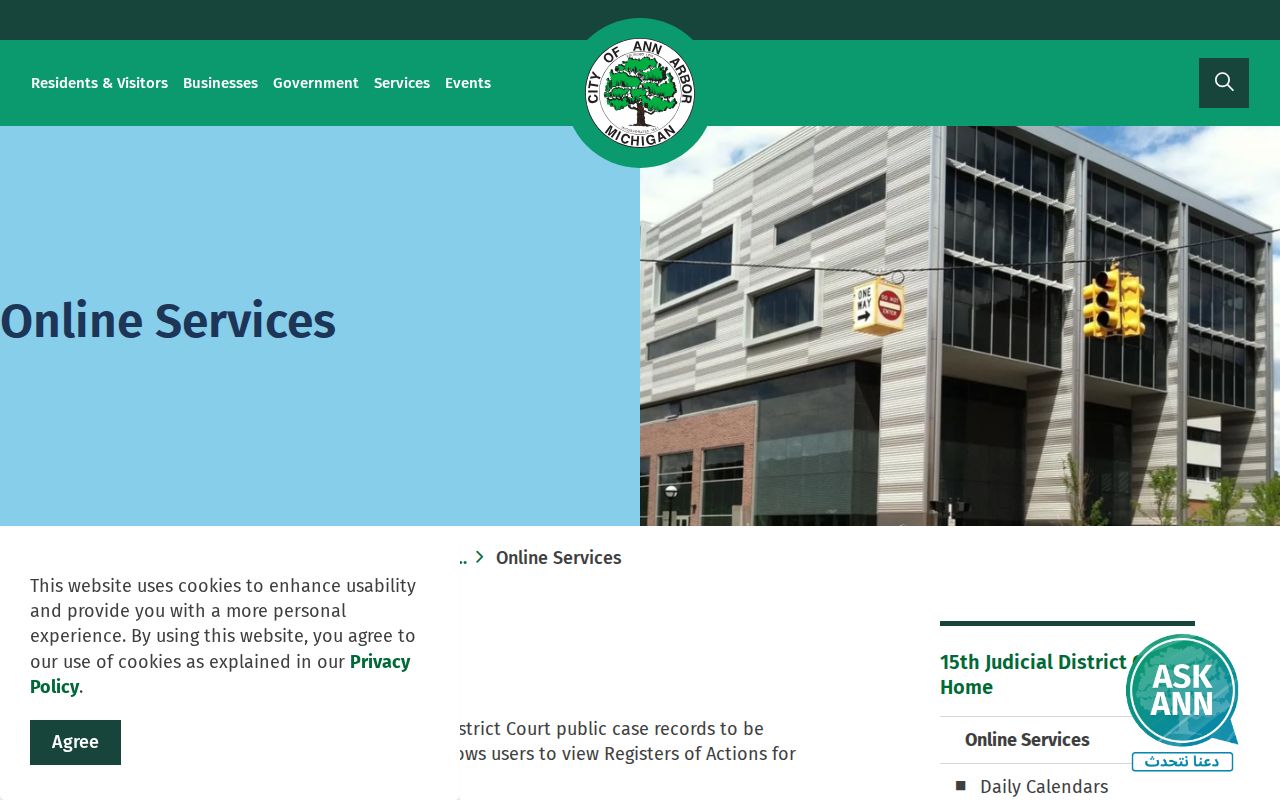
Search, payment, and record requests each answer a different question. Pick the Ann Arbor court docket channel that fits whether you need a case date or a specific record.
Where Ann Arbor Cases End Up
Not every Ann Arbor case stays in one building. Matters within district jurisdiction remain at the 15th District Court. A felony may begin there. It then moves to the Washtenaw County Trial Court / 22nd Circuit Court after bindover.
Circuit-level civil, domestic-relations, family, juvenile, and probate files sit with their own custodians. They may never show up as a 15th case at all. Appeals live in the Michigan appellate systems rather than the trial-court view.
Docket flow: Ann Arbor district-court matter → Washtenaw County Trial Court / 22nd Circuit Court when jurisdiction or procedure sends it onward → Michigan Court of Appeals when appealed.
The court named on the case is always your first records contact. For routes across the whole county, the Washtenaw County court docket home page sums them up.
Ann Arbor Court Proceeding Records
A recording of a proceeding is not the same thing as an Ann Arbor court docket. To get a DVD, file the 15th District proceeding-copy form. It asks for the case, party, judge, courtroom, date, time, and proceeding type. The listed fee is $20. Without a court order, only parties and attorneys may request a copy. Use of that copy is restricted.
Filing the form does not convert a public search result into a download. A case history helps you gather the event details the form needs. The court itself decides access and processing under its own rules. The Ann Arbor payment instructions are a separate service entirely.
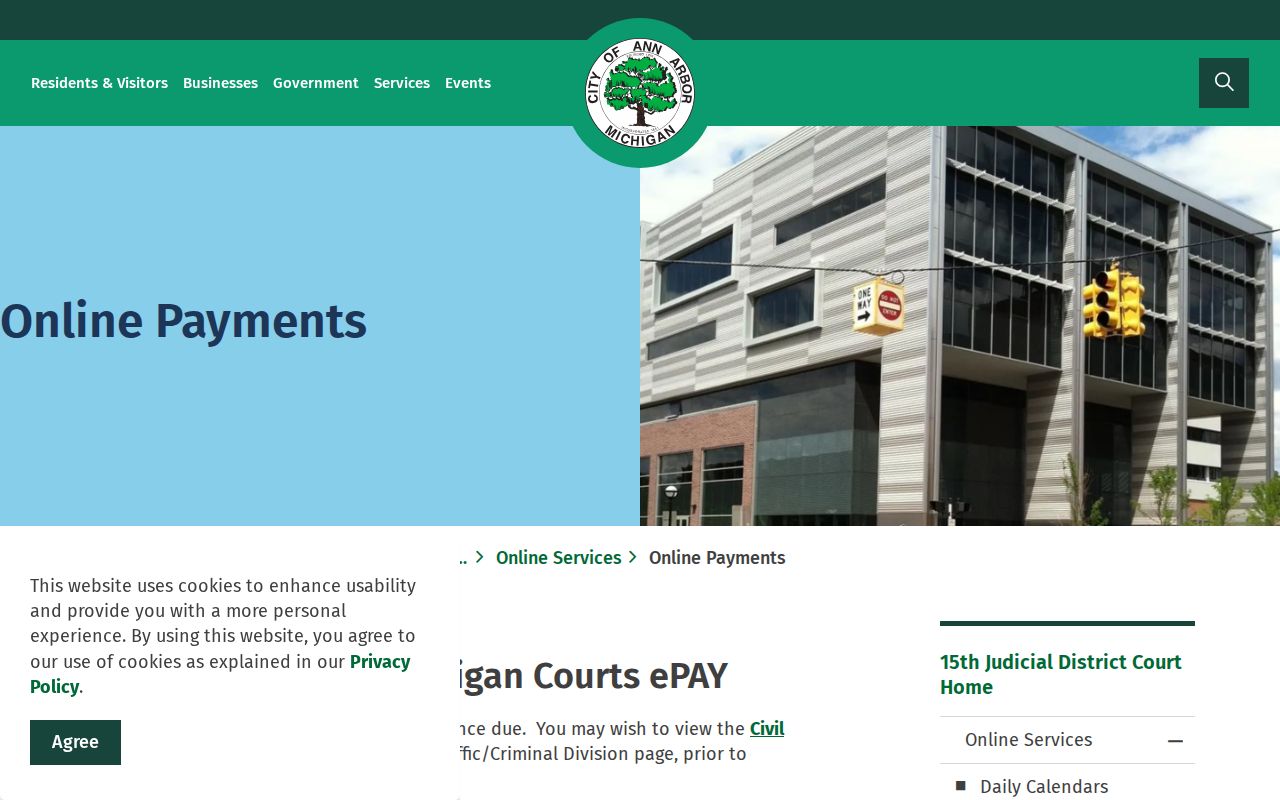
Docket access, payments, and proceeding-media requests each use their own official Ann Arbor channel.
Public Access to Ann Arbor Court Records
Michigan court records are generally open under the court rules. A statute, rule, administrative order, or specific court order can limit access anyway. For Ann Arbor cases, the 15th District Court is the right records contact.
A public Register of Actions can list events. It keeps attachments and personal identifiers out of view. Want an older file, a full copy, or a certified record? Contact the court that held the case. Give the case number plus the document or proceeding you need.
Key rules:
MCR 8.119 makes trial-court records generally public while preserving restrictions and redaction requirements.
MCR 8.116 addresses public access to proceedings, which is related to but distinct from document access.
MCL 15.232 means court records do not default to a county FOIA request; use the court’s records procedure.
Ann Arbor Court Docket Gaps
Every Ann Arbor court docket search has limits worth knowing. The 15th public search does not reach cases closed before August 5, 2006. MiCOURT excludes many nonpublic categories too.
A missing case can mean several things. The court could be wrong. The spelling could differ. A criminal sentence display limit of seven years could apply, indexing could lag, or the record could be restricted. One empty result does not prove a person or event has no court history.
For an authorized request, use the court's records process. Public search data is informational only. The clerk can point you to the right channel for a case history, filed document, certified copy, or restricted material.
Note: Court staff can explain access mechanics and records routing. They cannot give legal advice or change an order through a records request.