
How to Search Washtenaw County Civil Dockets
The fastest public route is MiCOURT Case Search. Pick the court first, then search by party name or by Year/Number/Type. Washtenaw County keeps its records, calendars, and lower-court access on separate channels. The county's records page sends docket searches to MiCOURT. Use the case number when you have it. With only a name, check the court, the party role, the civil type, and the filing date, since common names pull up unrelated cases.
Remember that a docket is only an index. It may list a complaint, motion, order, or judgment without showing the document itself. When you need the actual paper, ask the court holding the Washtenaw County case about inspection, a plain copy, a certified copy, or another records option.
- Identify whether the Washtenaw County matter belongs in district, circuit, probate, or a family division.
- Select that court in MiCOURT or use its official local online-services link.
- Search by party name or enter the separate Year, Number, and Type values when a case number is known.
- Open the matching public case history and confirm the court, case type, parties, and filing date.
- Use the court of record for a document, a current setting confirmation, or an authenticated copy.
Note: A Washtenaw County civil docket can point you to the right case. That does not mean every filing or attachment is available online, so the court itself may hold what the docket only names.
Washtenaw County Civil Court Divisions
Jurisdiction comes first. The 22nd Circuit Court sits within the Washtenaw County Trial Court system. It generally handles civil matters over $25,000 along with other circuit-level work. Smaller civil claims go to the district courts. These also cover small claims and landlord-tenant cases. Ann Arbor is served by the 15th District Court. 14A covers much of the county, and 14B serves Ypsilanti Township. So where the dispute arose matters as much as what it is about when you pick a docket to search.
The county's own court-divisions page lays out the functions inside the local court system. These include civil, criminal, family, Friend of Court, juvenile, peacemaking, probate, and problem-solving work.
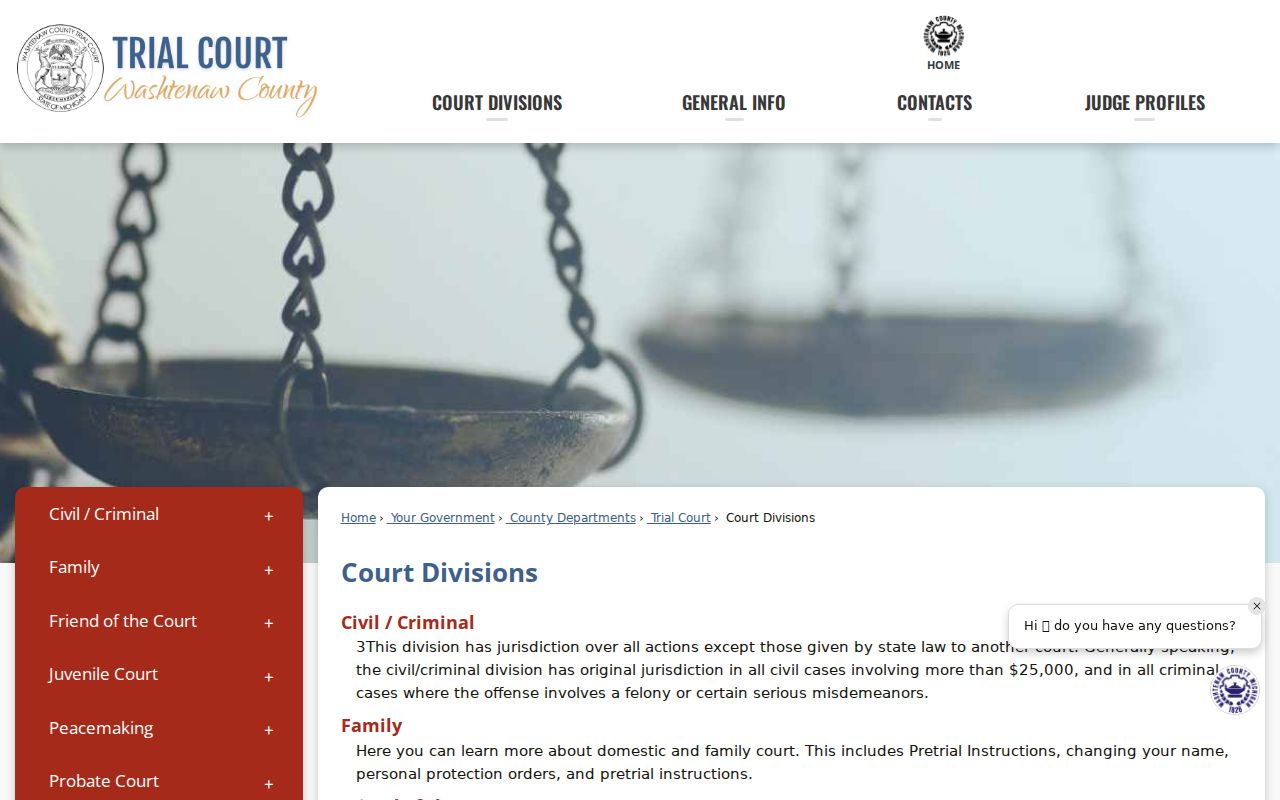
The division list is a reminder that a county name is not a single court. Match the civil docket to the right division before you search.
| Washtenaw County court | Typical civil docket | Search starting point |
|---|---|---|
| 22nd Circuit / Trial Court | General civil matters over $25,000 and other circuit jurisdiction. | MiCOURT, Trial Court Court Services, and the county records route. |
| 14A District Court | District civil, small claims, and landlord-tenant matters outside Ann Arbor and Ypsilanti Township. | County 14A links and MiCOURT. |
| 14B District Court | District matters arising in Ypsilanti Township. | 14B clerk and MiCOURT. |
| 15th District Court | Ann Arbor general civil, small claims, and landlord-tenant matters. | 15th District services and MiCOURT. |
What a Washtenaw County Civil Docket Shows
A civil docket in Washtenaw County is the clerk's chronological record, sometimes called a register of actions or case history. Expect to see the case number and type, party roles that are public, the filing date, service entries, answers, motions, notices, settings, orders, judgments, and later collection or appeal references. The docket does not decide truth. For that, read the operative language in the actual filed order or judgment.
| Case number and type | The court-assigned civil identifier, such as a court-specific GC, LT, SC, SP, or GZ classification. |
|---|---|
| Parties | Public plaintiff and defendant or other party-role labels used to identify the case. |
| Filing history | Entries for initiating papers, answers, service, motions, notices, and orders. |
| Settings | Scheduled hearing, mediation, case evaluation, or trial-related events when publicly displayed. |
| Disposition | A docket status, dismissal, judgment, default, settlement, or appeal reference that needs the actual order for full meaning. |
| Access status | Public, redacted, nonpublic, or restricted information as identified by the court record. |
Take a filed motion as one example. It is a request, not proof the court granted anything. A default judgment works the same way: read the judgment entry and the current case history before drawing a conclusion.
Washtenaw County Civil Case Types
Case-type codes explain what a Washtenaw County docket result represents. The 15th District Court's public case-search information lists them. GC is General Civil, LT is Landlord-Tenant, and SC is Small Claims. SP is Land Contract Summary Proceeding. GZ is Miscellaneous Civil. These labels sort cases into categories. They tell you nothing about the facts, the remedy sought, or the result.
| Case type | Where it commonly appears | Docket reading point |
|---|---|---|
| General civil | District civil jurisdiction or circuit civil matters, depending on the claim and court. | Look for complaint, answer, motion, discovery, hearing, judgment, and appeal entries. |
| Landlord-tenant | District civil docket. | Possession, summons, hearing, judgment, escrow, payment, or writ-related entries may appear. |
| Small claims | District court small-claims docket. | The simplified process still has a case history and a court-specific setting. |
| Land contract summary proceeding | District court civil docket when jurisdiction applies. | Use the case type and court number to distinguish it from a general civil result. |
For the official list of these case-type codes, the 15th District Court's case-search page is the source to trust.
Types of Civil Cases on the Washtenaw County Docket
Civil dockets in Washtenaw County cover a wide range of private disputes and court-administered matters. Where you search depends on the court and the value of the claim. Circuit civil generally means claims over $25,000. At the 15th District Court, general civil runs up to $25,000. Small claims stops at $7,000. That $7,000 figure is a jurisdictional ceiling. It does not promise every small-claims docket carries the same remedy or timeline.
- General civil cases involving claims within the district or circuit court’s jurisdiction.
- Small claims matters within the $7,000 ceiling described by the 15th District Court.
- Landlord-tenant cases, which are district civil matters.
- Land contract summary proceedings and other civil categories identified by court type codes.
- Family and probate-related matters held by the appropriate Trial Court division when publicly accessible.
Small claims may also go through mediation. Local court information names the Washtenaw Dispute Resolution Center, MI-Resolve, and Zoom as options. A mediation entry is just a process step, though. It does not establish a settlement or a judgment by itself.
Settings and Hearings on Washtenaw County Civil Dockets
A civil setting is a scheduled court event. It is not automatically the trial. A Washtenaw County civil docket can list a hearing, mediation, case evaluation, a motion date, or another calendar entry. Between settings, expect service, discovery, settlement, default, judgment, garnishment, or appeal activity to appear. Always read the later entries before assuming an earlier hearing still stands.
The local court calendar helps confirm a public setting. But it can leave out nonpublic matters and rarely explains why an event was set. Pair the docket history with the Washtenaw County court calendar for date-finding channels and change notices.
When time or location matters, confirm with the court of record. Calendars update as scheduling changes come in. Court staff can explain the current retrieval channel even though they cannot give legal advice.
Reading Washtenaw County Civil Docket Terms
Civil docket shorthand can look conclusive when it is not. The terms below describe frequent case-history events in Washtenaw County civil records. When wording, deadlines, or legal effect matter, the actual pleading, order, or judgment controls.
- Complaint
- The initiating civil filing that states a claim or requests relief.
- Answer
- A responding filing from a party; its entry does not resolve the dispute.
- Default judgment
- A judgment entered after a party fails to respond or appear under the applicable rules.
- Case evaluation
- A case-management or dispute-resolution event that may appear as a civil setting.
- Garnishment
- A collection-related docket status or proceeding that should be read with the related order.
A case marked disposed or closed is no longer active in the court in that same posture. That label by itself settles nothing about the facts the parties raised.
Public Access to Washtenaw County Civil Dockets
Michigan Court Rule 8.119 governs public access to a Washtenaw County civil docket. The rule starts from openness. Trial-court records are public unless a statute, a court rule, an administrative order, or a particular order of the court restricts them. Electronic public records can be inspected and copied. Protected identifiers must be redacted first. A public case history therefore does not expose every attachment or personal detail.
FOIA does not fill the gap. Michigan's judiciary sits outside the FOIA definition in MCL 15.232. So does a county clerk acting as circuit-court clerk. Send a court-file request to the clerk of the court holding the case rather than treating it as a general county FOIA matter.
When a civil record is nonpublic, the court-record privacy and access policy spells out how the court responds to the request.
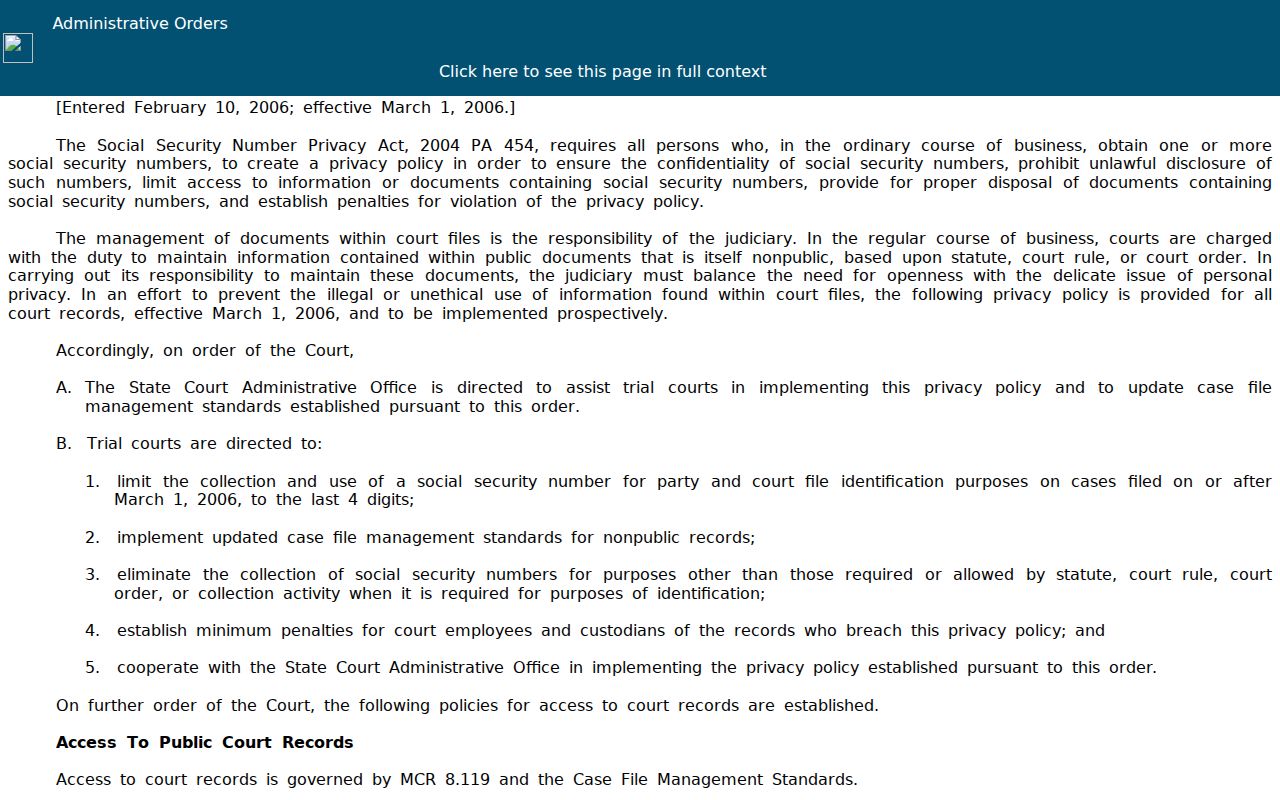
If a civil case is sealed or nonpublic, the court's authorized-access process is the proper route. Trying to fill in the gaps from public search results is not.
Key rules: MCR 8.119 provides the main public-access rule for trial-court records and protects required redactions.
MCL 15.232 excludes the judiciary and circuit-court clerk functions from ordinary FOIA treatment.
Public docket availability does not make a restricted attachment, protected identifier, or nonpublic case available for general access.
Washtenaw County Civil Record Copies
A Washtenaw County civil docket can point to an order or judgment with no public image. A copy request starts with details. Identify the court, the case number, the document or proceeding, and the approximate date, then ask the court of record which request method and authentication level apply. The clerk decides both. Fee tiers matter too. The county's posted fee information distinguishes plain, certified, and exemplified copies, and it lists no general e-access or document-image fee, so confirm the cost before assuming online delivery.
Certified and exemplified copies have a statutory framework. It comes from MCL 600.2546.
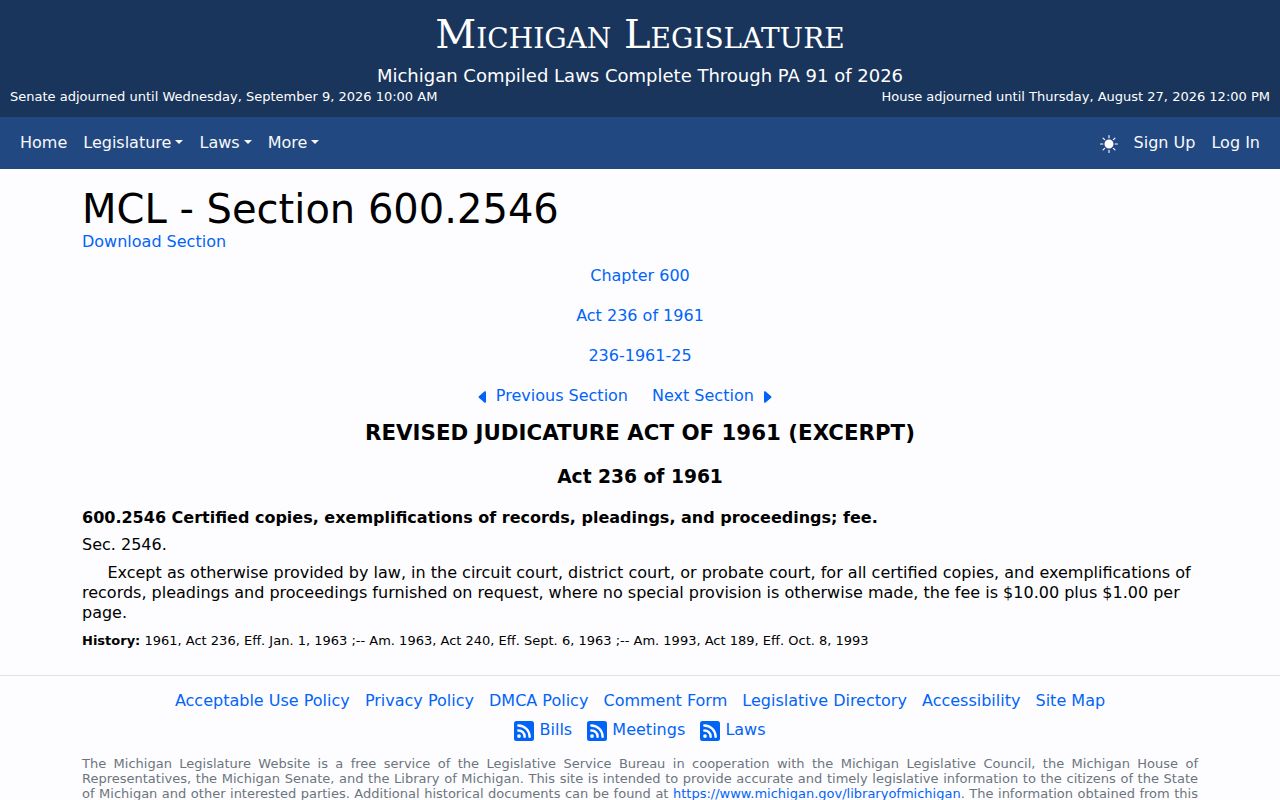
The statute and the county fee schedule both matter when a docket entry calls for an authenticated court reproduction. An informational search view will not do that job.
| Washtenaw County copy type | Posted fee | Use |
|---|---|---|
| Plain copy | $2 per page | A regular reproduction of an available court record. |
| Certified copy | $10 plus $1 per page | A clerk-authenticated reproduction when certification is required. |
| Exemplified copy | $10 plus $1 per page | An additional authentication format; confirm the required form with the receiving institution. |
Note: A certified copy and an exemplified Washtenaw County civil copy serve different authentication roles. Ask the receiving institution which one it requires.
MiFILE and Washtenaw County Civil Dockets
MiFILE is Michigan's electronic filing workflow. It does not replace a public Washtenaw County civil docket search. The available-courts information names both Washtenaw Trial Court and the 15th District Court. Attorneys are mandated filers where that list says so. Other filers are generally marked not mandated. Filing availability can change, so the official court list controls rather than anything inferred from a public docket.
MiFILE does explain one thing. A recent filing can carry an electronic history because it moved through the system. A MiFILE sign-in is different. It does not create a public case-search account. For public case information, use MiCOURT. Select the court there, or use the court's records and online-services channel. When an image is missing or a docket entry looks wrong, ask the clerk what record is publicly inspectable and which copy request applies.